The Ultimate Ecommerce Tracking Guide: GA4, Enhanced Conversions, Meta CAPI & Attribution Setup
- How to set up GA4 ecommerce events and validate purchase tracking
- How Enhanced Conversions and Meta CAPI recover lost signal
- How to structure Google Tag Manager and deduplicate Meta events
- Which attribution model to trust before making budget decisions
The Most Expensive Ecommerce Mistake Isn't Bad Advertising. It's Bad Tracking.
Every month, ecommerce businesses spend thousands - sometimes hundreds of thousands - on advertising. But many are making major marketing decisions using inaccurate data.
They optimize campaigns, test creatives, adjust budgets and launch promotions. Then they believe Google Ads is underperforming, think Meta isn't profitable and assume certain campaigns should be paused. In reality, their tracking is broken.
The consequences are enormous: winning campaigns get shut down, poor-performing campaigns keep receiving budget, leadership loses confidence and growth slows. The good news is that most tracking issues are fixable.
The ecommerce brands winning in 2026 aren't simply spending more. They're measuring better.
Why Ecommerce Tracking Matters More Than Ever
Privacy updates, cross-device behavior, ad blockers, browser restrictions and multiple touchpoints have made the customer journey complex. A shopper may click a Meta ad, visit through mobile, return via Google Search, complete the purchase on desktop and open an email before converting.
Without proper tracking, attribution becomes unreliable. The cost of bad tracking shows up everywhere:
- Incorrect ROAS and misleading customer acquisition cost
- Duplicate purchases and missing revenue
- Misallocated budgets and poor optimization decisions
According to the Baymard Institute, the average cart abandonment rate sits near 70%, so every conversion you fail to record makes profitable campaigns look far weaker than they are.
The 2026 Ecommerce Tracking Stack
Every layer of your measurement stack matters. Data flows through a chain, and a break at any point corrupts everything downstream.

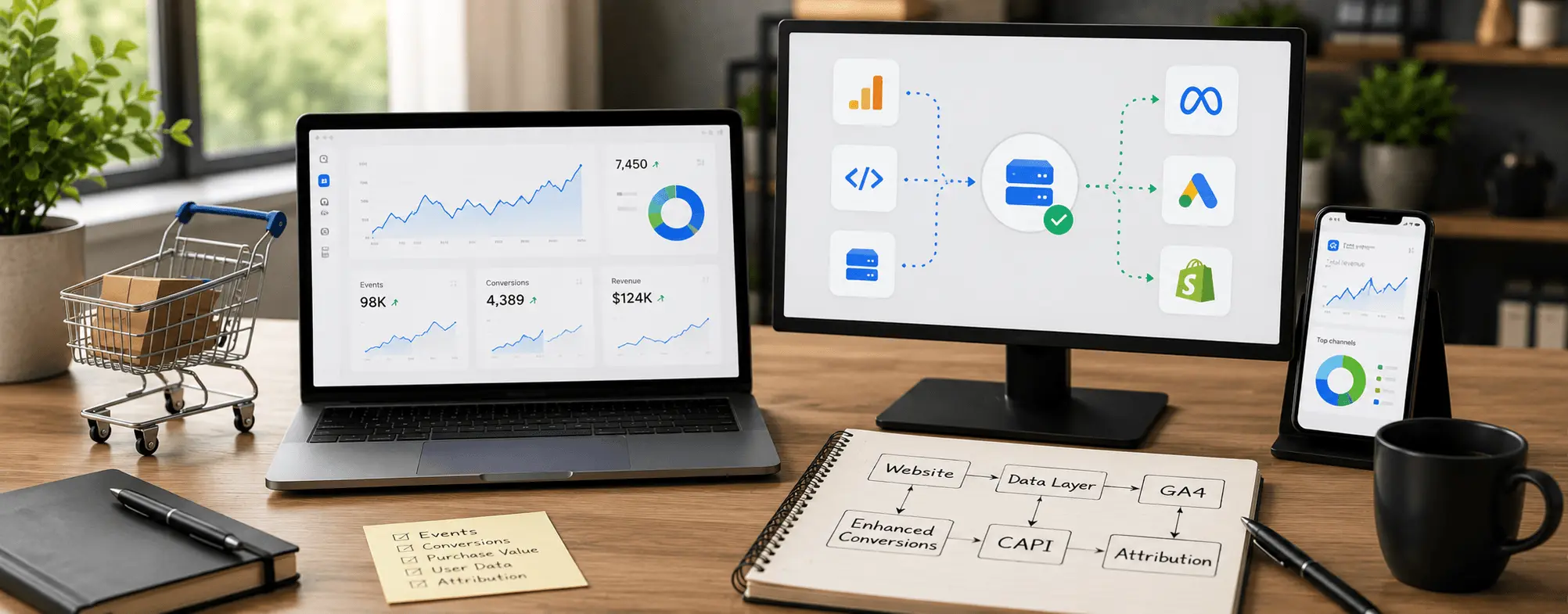
The order is deliberate. Your website fires events, Google Tag Manager organizes and deploys them, GA4 becomes your measurement foundation, Enhanced Conversions and Meta CAPI restore signal lost to privacy changes, and attribution translates all of it into decisions you can trust. Get the sequence right and your performance marketing decisions rest on solid ground.
Step 1: GA4 Ecommerce Setup
GA4 is the foundation of ecommerce measurement, tracking behavior across devices and channels. Before anything else, validate that these core events fire correctly:
- view_item - product pages viewed
- select_item - products selected
- add_to_cart - items added to cart
- begin_checkout - checkout started
- add_payment_info - payment details entered
- purchase - order completed
The funnel reads cleanly: product view then add to cart then begin checkout then payment information then purchase. Your purchase event must pass transaction ID, revenue value, currency, product information, quantity, and tax and shipping when applicable.
One of the most common mistakes is incomplete purchase data, where revenue appears inaccurate because critical parameters are missing. Google's own GA4 ecommerce documentation lists every parameter each event expects - use it as your validation checklist.
Step 2: Validate Purchase Tracking
Purchase tracking is the heartbeat of ecommerce reporting. If purchases are inaccurate, nothing else matters. Complete a test order and verify that:
- Transaction IDs fire correctly
- Revenue matches actual sales
- Products appear accurately
- No duplicate purchases exist
The most common issues fall into predictable buckets:
- Inflated revenue
- Double-counted orders
- Marketing looks weaker
- Under-reported revenue
- Misleading ROAS
- Wrong budget calls
- Parameters not passing
- Empty product data
When The Dashboard Said Ads Were Failing
An ecommerce business believed advertising performance had deteriorated. GA4 revenue appeared significantly lower than actual sales, so leadership prepared to cut budgets.
Investigation found three issues:
- Purchase values weren't consistently passing
- Certain payment methods bypassed tracking entirely
- Duplicate events existed on some orders
Once corrected, leadership regained confidence. The campaigns weren't failing. Measurement was. See how measurement fixes fit a broader turnaround in our multi-year growth case study.
Step 3: Enhanced Conversions Setup
Enhanced Conversions improve attribution accuracy by securely using hashed first-party data such as email addresses, phone numbers and customer details. They help recover conversion visibility lost to privacy restrictions, browser limitations and cross-device behavior.
The workflow is straightforward: customer completes purchase then first-party data is captured then data is hashed securely then Google matches signals then attribution improves.
You can implement it three ways:
- Google Tag Manager - recommended for flexibility
- Google Tag - simpler to deploy
- Native ecommerce integrations - built into many platforms
Common mistakes include not enabling the feature at all, passing incorrect variables, missing customer information and failing to test. Google's Enhanced Conversions help documentation walks through the variable mapping so hashed data matches correctly.
Step 4: Google Tag Manager (GTM)
GTM centralizes tag deployment, letting businesses manage events, reduce developer reliance and improve testing. A clean container structure keeps everything auditable.
- GA4 configuration tag
- Ecommerce event tags
- Enhanced conversion variables
- Data layer variables
- Meta Pixel events
- Custom events
Before publishing, run through a testing checklist: preview mode validation, event sequencing, variable inspection and cross-browser testing.
Many businesses assume GTM implementations remain healthy indefinitely. They don't. Theme updates, app installs and platform changes silently break tags, which is why regular audits are essential.
Can You Trust Your Numbers?
We review GA4 implementations, purchase tracking, Enhanced Conversions, GTM configurations, Meta Pixel setups, Meta CAPI implementations and attribution models.
- Full implementation review & purchase validation
- Revenue reconciliation & Meta diagnostics
- Attribution analysis & prioritized action plan
Step 5: Meta Pixel Setup
Meta relies heavily on event data for optimization. Without accurate signals, performance suffers and the algorithm optimizes toward the wrong outcomes. Configure these recommended events:
- ViewContent - product and content views
- AddToCart - items added to cart
- InitiateCheckout - checkout started
- Purchase - completed orders with accurate values
- Lead - when applicable to your funnel
The usual problems mirror GA4: duplicate events, missing purchases, inconsistent event values and incorrect event prioritization. Accurate Pixel data is also what feeds your remarketing audiences, so it directly affects conversion and retargeting efficiency.
Step 6: Meta Conversion API (CAPI)
CAPI sends events directly from your servers rather than relying exclusively on browsers. As browser restrictions increasingly limit client-side tracking, CAPI restores signal quality.
The workflow deduplicates carefully: customer action then browser event then server event then event deduplication then Meta attribution. The benefits are meaningful:
- Better event reliability and improved optimization
- Greater resilience against browser and privacy changes
- Stronger, more complete attribution
You can implement it through partner integrations (Shopify, BigCommerce, WooCommerce), GTM server-side, or custom development. Meta's Conversions API documentation details the payload and event-matching requirements.
Without proper deduplication, the same purchase may be counted twice. Ensure event IDs align and that your browser and server events reconcile against each other.
Step 7: Cross-Channel Attribution
Modern journeys rarely involve a single touchpoint. A typical path might be Meta ad then Google search then email click then purchase. Who gets credit depends entirely on your model:
- Last click - credits the final interaction
- First click - credits discovery
- Data-driven attribution - distributes value based on contribution
- Position-based - balances first and last interactions
Our recommendation is to use data-driven attribution whenever possible, then supplement with channel-specific reporting. Longer, more fragmented buyer journeys - a pattern Think with Google has tracked for years - make single-touch models increasingly misleading.
Leadership should monitor revenue by channel, ROAS, customer acquisition cost, conversion rates, new versus returning customers, assisted conversions and customer lifetime value. When these numbers are trustworthy, your growth marketing decisions compound instead of guessing.
The Most Common Ecommerce Tracking Mistakes
Across dozens of audits, the same seven mistakes appear again and again:
- Trusting setups without regular audits
- Failing to validate purchases with a test order
- Ignoring Enhanced Conversions
- Relying solely on browser events
- Improper Meta deduplication
- Using incomplete attribution models
- Making budget decisions from inaccurate reports
With cart abandonment averaging around 70%, every purchase you fail to record makes profitable campaigns look far worse than they are - and invites the wrong budget cuts.
The Ecommerce Tracking Checklist
Use this as your quarterly review. Each layer should pass before you trust the numbers above it.
- Ecommerce enabled
- Purchase validated
- Revenue accurate
- Events tested
- Variables verified
- Preview reviewed
- Enabled
- Customer data captured
- Matching tested
- Events firing
- Purchase values accurate
- Prioritization configured
- Server events active
- Deduplication validated
- Data-driven model reviewed
- Channel contributions understood
- Assisted conversions monitored
Get An Expert Tracking Audit
Our comprehensive tracking assessment includes full implementation reviews, purchase validation, revenue reconciliation, Meta diagnostics, attribution analysis and prioritized action plans.
Book An Expert Tracking AuditFrequently Asked Questions
Final Thought
Tracking isn't a technical checkbox. It's the foundation of every marketing decision you make. If your measurement is flawed, your optimization becomes flawed. If your attribution is inaccurate, your investments become inefficient.
The ecommerce brands winning in 2026 aren't simply spending more - they're measuring better. When you trust your data, you make smarter decisions, and smarter decisions compound into sustainable growth. When you're ready to build a measurement foundation you can trust, our growth marketing team can help.
Ready To Trust Your Data Again?
Bad tracking quietly drains ecommerce budgets. Let our specialists validate your GA4, Enhanced Conversions, Meta Pixel, CAPI and attribution so every decision rests on accurate numbers.