Why Most Agencies Fail Ecommerce Brands (And What a True Growth Team Looks Like)

- Why the traditional account-manager agency model rarely drives real growth
- The four hidden problems that quietly stall ecommerce brands
- Why CRO and retention are the most ignored levers in most agencies
- What a specialist-led, full-funnel growth team actually looks like
The Agency Model Is Broken
If you've worked with an ecommerce marketing agency before, you've probably experienced this story.
The sales process was impressive, the promises convincing, you were introduced to "experts," and weekly reports looked polished. For the first few months optimism was high.
Then reality set in: traffic increased but revenue didn't, advertising spend grew but profitability declined, communication became reactive and recommendations slowed. Eventually you asked the question countless founders ask every year: "Why aren't we growing?"
The problem isn't always a lack of effort. More often, it's the agency model itself, which was never designed to solve the complex challenges modern ecommerce businesses face.
Most agencies are structured to maximize internal efficiency, not client outcomes.
The Harsh Reality: Most Agencies Aren't Built for Growth
Scaling an ecommerce brand in 2026 requires much more than managing ad accounts. It requires aligning every stage of the customer journey. The traditional agency model usually flows in a straight line:
- Sales team wins the account
- Account manager takes over the relationship
- Execution team runs the work behind the scenes
- Monthly report closes the loop
The client relationship revolves around the account manager while specialists remain hidden. That structure feels organized, but it quietly separates the people making strategic decisions from the people with the deepest expertise. Compare this with a genuine growth marketing approach, where specialists shape strategy directly.
The Problem With the Account Manager Model
Account managers play an important role, but problems emerge when they become the primary strategic decision-makers.
1. Limited Technical Depth
Many account managers are excellent communicators but may lack hands-on expertise in Google Ads and Meta Ads, CRO, email marketing, AI SEO, technical SEO, and tracking and attribution. As a result, complex opportunities go unnoticed.
2. Recommendations Become Generic
When one person manages multiple accounts, strategies become repetitive and industry nuances disappear. Every brand ends up with a version of the same playbook.
3. Delayed Decision-Making
Questions move through layers: client to account manager to specialist, then back through account manager to client. Momentum slows and small decisions take days.
4. Reporting Replaces Strategy
Meetings focus on clicks, impressions and spend instead of profitability, customer lifetime value and growth opportunities. Activity looks busy, but it rarely compounds into revenue.
A polished monthly report is not the same as growth. If your meetings review vanity metrics instead of profit and lifetime value, the model is optimizing for reassurance, not results.
Why Ecommerce Brands Need Specialists
Modern ecommerce growth is too complex for one generalist. Sustainable scaling requires deep expertise across several disciplines at once:
- Google Ads
- Meta Ads
- Shopping campaigns
- Audience testing
- Product pages
- Checkout flow
- Mobile usability
- Testing frameworks
- Lifecycle automations
- Retention systems
- Segmentation
- Organic visibility
- Generative search
- Technical health
- Content strategy
- GA4
- Enhanced Conversions
- Meta CAPI
- Cross-channel reporting
- Win-back programs
- Loyalty initiatives
- Replenishment flows
No single person can master every discipline at an elite level. The brands growing profitably build specialist teams instead of relying on one generalist.
The Specialist-Led Model
In a specialist-led structure, a growth strategist coordinates a team of experts: a performance specialist, a CRO specialist, an SEO and AI SEO specialist, an email specialist and a tracking specialist. Each expert contributes from their area, producing smarter decisions, faster execution and better outcomes.
Discover What's Holding Your Growth Back
Most stores lose revenue through blind spots that generalist account management never surfaces. Book a free growth audit and get a personalized review covering:
- Acquisition performance & conversion opportunities
- Retention systems & tracking accuracy
- SEO & AI SEO readiness and revenue leaks
Why Agencies Fail: They Focus Only on Acquisition
One of the biggest mistakes is an obsession with traffic. The conversation revolves around "How can we get more visitors?" Rarely does anyone ask "What happens after they arrive?"
The consequences compound quietly: advertising spend increases, conversion rates stagnate, repeat purchases remain low, customer lifetime value suffers and profitability declines.
The Missing Piece: CRO
Many agencies run ads directly into unoptimized experiences, yet conversion rate optimization is often the highest-leverage opportunity available. Common opportunities ignored include weak product pages, hidden trust signals, poor mobile experiences, complicated checkout flows, missing sticky add-to-cart and ineffective navigation.
You cannot buy your way out of a poor customer experience. More traffic simply amplifies inefficiencies.
The Missing Piece: Retention
Another blind spot is retention. Many agencies stop thinking once the purchase happens, but revenue doesn't end at checkout. Ignoring retention means missing opportunities to increase lifetime value, improve profitability, reduce acquisition pressure and strengthen loyalty.
Essential systems most brands are missing include:
- Welcome flows
- Post-purchase education
- Cross-sell campaigns
- Win-back sequences
- VIP programs
- Loyalty initiatives
Acquiring a new customer can cost roughly five times more than retaining an existing one, yet retention is exactly where most agencies stop investing.
These retention systems are the backbone of a strong email and SMS program, and they compound month after month.
The Problem With Siloed Execution
Many agencies divide teams into isolated departments: paid media doesn't communicate with SEO, SEO doesn't coordinate with email, and email doesn't collaborate with CRO. Everyone focuses on their own metrics and no one owns the entire customer journey, resulting in fragmented experiences, conflicting priorities and missed opportunities.
Research consistently shows that customer experience, not channel volume, is what separates leaders from laggards. McKinsey and Harvard Business Review have both documented how retention and experience drive outsized profitability compared with acquisition alone.
The Growth Team Framework
The strongest teams organize around revenue, not channels. Instead of isolated departments chasing separate metrics, four teams align to the customer journey.
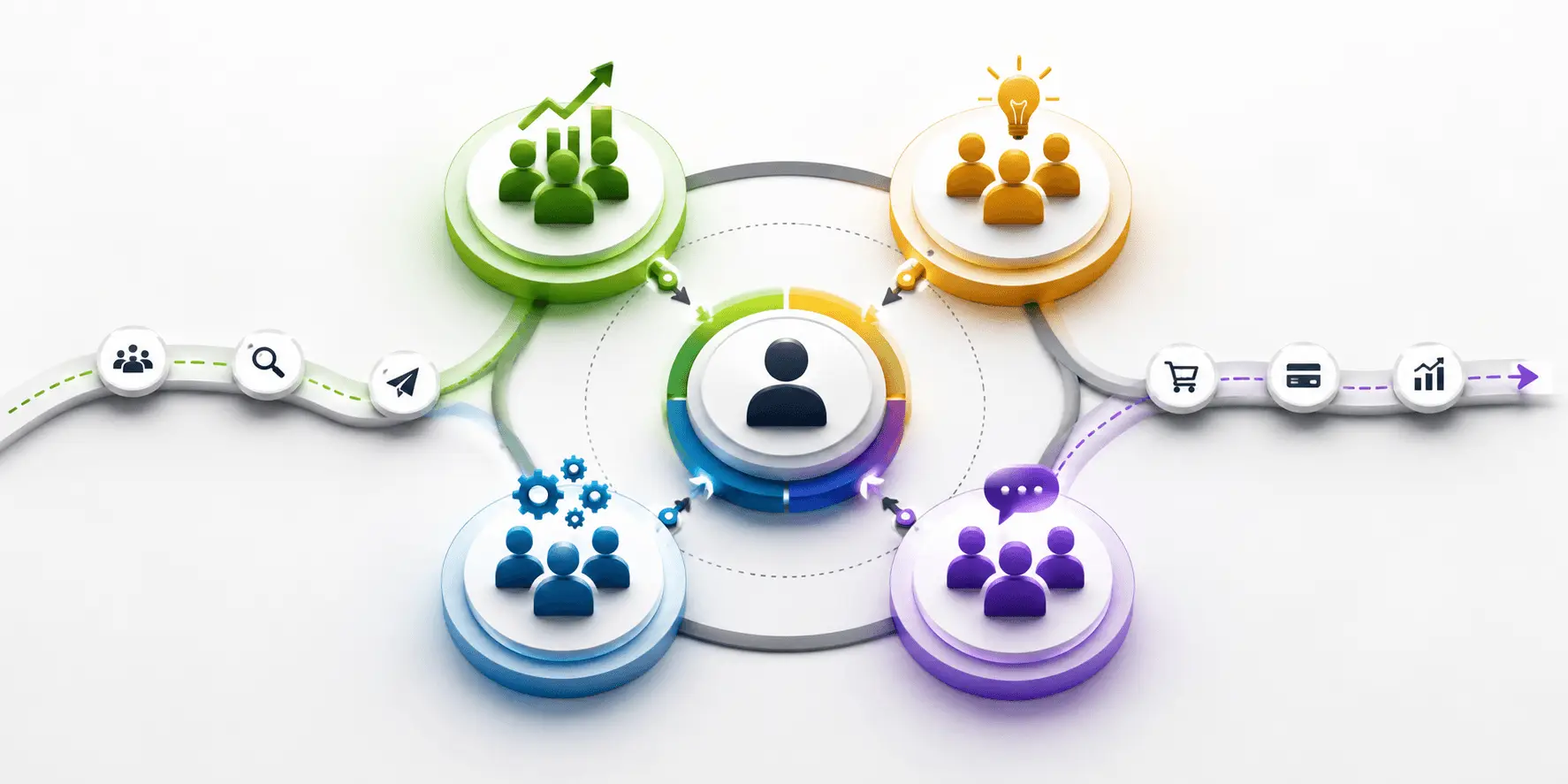
Awareness
SEO, AI SEO, paid social, paid search and content. Goal: generate qualified demand. This is where a modern SEO strategy and AI search visibility reduce dependence on paid channels over time.
Team 2Conversion
CRO, product experiences, checkout optimization and mobile usability. Goal: convert demand efficiently so every visitor is worth more.
Team 3Retention
Email marketing, SMS, loyalty programs, replenishment and win-back campaigns. Goal: increase customer lifetime value and profitability.
Team 4Intelligence
GA4, Enhanced Conversions, Meta CAPI, attribution and reporting. Goal: enable smarter decisions with data you can actually trust.
Rather than asking "How are our ads performing?" growth teams ask where customers are dropping off, which channels generate the highest LTV, how to improve conversion efficiency, which segments to retain and which experiences need optimization. The focus shifts from campaigns to outcomes.
Case Study: The Agency Trap
Strong Budgets, Polished Reports, No Growth
An ecommerce business came to us after working with multiple agencies. They had strong advertising budgets, monthly reports and dedicated account management, but they were missing the systems that actually drive profit:
- No CRO initiatives
- No email retention systems
- No reliable attribution
- No SEO expansion
- No cross-functional collaboration
Growth plateaued, acquisition costs increased and profitability declined. Instead of replacing channels, we changed the operating model:
- CRO improvements: trust signals, mobile optimization, checkout enhancements
- Retention systems: lifecycle automations, win-back campaigns, VIP experiences
- SEO expansion: educational content, AI SEO readiness, category optimization
- Attribution reviews to restore confidence in the data
Revenue efficiency improved and growth became more sustainable. The difference wasn't working harder. It was working together. See a full multi-year growth case study here, or browse more client results.
Why Growth Stack Funnels Was Built Differently
Growth Stack Funnels wasn't created to be another traditional agency. It was built around a simple belief: ecommerce brands deserve access to specialists, not just account managers.
Our approach brings together experts across performance marketing, growth marketing, SEO, AI SEO, CRO, email marketing and tracking and attribution, with every recommendation designed around one objective: sustainable revenue growth. Not vanity metrics. Not channel silos. Real business outcomes.
What Makes Us Different
- Specialist-led execution
- Full-funnel thinking from acquisition to advocacy
- A CRO-first mindset
- A genuine retention focus
- Data-driven decisions
- Revenue accountability
Is Your Agency Helping You Grow?
Ask yourself a few honest questions:
- Are recommendations proactive?
- Is CRO part of the strategy?
- Is retention prioritized?
- Do specialists contribute directly?
- Can you trust your reporting?
- Is the entire customer journey being optimized?
If the answer to several of these is "no," it may be time to rethink your growth model.
Book an Expert Ecommerce Audit
Our comprehensive growth assessment includes channel analysis, CRO evaluations, lifecycle reviews, attribution diagnostics and a prioritized growth roadmap, built by specialists rather than a single account manager.
Schedule Your Growth Strategy SessionFrequently Asked Questions
Final Thought
The future of ecommerce growth won't be built by agencies chasing vanity metrics. It will be built by teams that understand the entire customer journey, combine specialists instead of relying on generalists, and optimize beyond the click.
Sustainable growth is created through alignment. The brands that embrace this mindset won't simply grow faster, they'll grow smarter. And in 2026, that's the ultimate competitive advantage. When you're ready to build a real growth system, our growth marketing team can help.
Ready To Work With a Real Growth Team?
Stop settling for polished reports and stalled revenue. Let our specialists review your funnel and build a growth system designed around outcomes.