The $100K/Month Email Marketing System: Every Flow Ecommerce Brands Need in 2026
- Why email still delivers the highest ROI of any ecommerce channel
- The nine core automated flows every store needs - and how to structure each one
- How email & SMS segmentation turns one-time buyers into repeat customers
- The KPIs that reveal whether your email program is actually working
Why Email Marketing Still Delivers the Highest ROI in Ecommerce
For years, marketers have predicted the death of email. Yet the brands generating consistent revenue are the ones that have mastered email marketing.
While advertising costs rise and organic reach becomes competitive, email remains one of the few channels you truly own. No algorithm changes. No bidding wars. No dependence on third-party platforms. Just direct communication with customers who have already shown interest.
Some of the highest-performing ecommerce brands generate 20-40% of total revenue through email marketing alone. The secret isn't sending more campaigns. It's building the right system.
The secret isn't sending more campaigns. It's building the right system.
This guide breaks down the exact email flows ecommerce brands need to build a predictable, scalable revenue engine. It pairs naturally with a strong conversion optimization foundation and a full growth marketing system.
The share of total revenue top ecommerce brands generate through email - a channel they own outright, according to benchmarks from Klaviyo.
Why Most Ecommerce Brands Leave Revenue on the Table
During audits we repeatedly uncover the same gaps. Each one quietly drains revenue that automation could recover.
- No welcome series for new subscribers
- Missing cart recovery emails
- No post-purchase nurturing
- One-size-fits-all messaging with no segmentation
- No VIP treatment for top customers
- No win-back strategies for lapsed buyers
- Large inactive subscriber lists hurting deliverability
As a result, visitors disappear, customers forget and revenue opportunities vanish. The encouraging part? Most of these leaks can be fixed with automation that runs in the background, day and night.
The average online cart abandonment rate sits near 70%, according to the Baymard Institute. Automated recovery flows are how you reclaim a meaningful share of that lost revenue without spending another dollar on ads.
The 9 Core Flows Behind a $100K/Month Email System
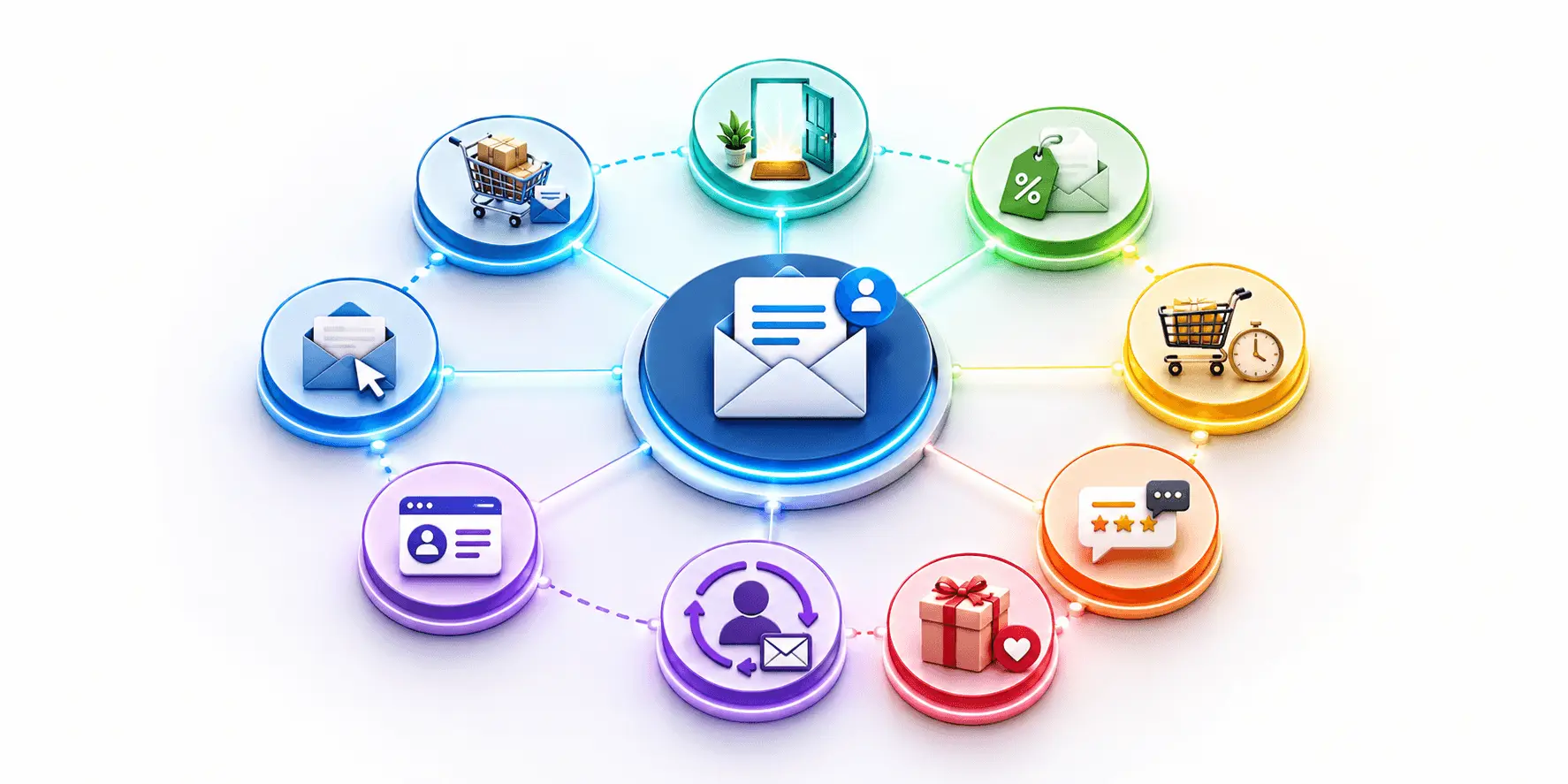
The system consists of nine core flows, each serving a specific purpose within the customer journey. Together they cover every stage from first signup to long-term loyalty.
Welcome Flow
Purpose: convert new subscribers into first-time buyers. The first few days after someone joins are when engagement is highest. Recommended structure:
Immediately - welcome and introduction
Day 1 - brand story
Day 3 - best sellers
Day 5 - social proof
Day 7 - offer reminder
Example subject lines: Welcome to the Family; Here's What Makes Us Different; Our Customers Can't Stop Buying These; Why Thousands Trust Us; Your Exclusive Offer Ends Soon.
Flow 2Browse Abandonment Flow
Purpose: recover interested visitors who viewed products but left. Many shoppers are researching and need reassurance, not pressure.
- Email 1 (4-6 hours): show recently viewed products
- Email 2 (24 hours): address objections and include FAQs
- Email 3 (48 hours): use reviews and social proof
Cart Abandonment Flow
Purpose: recover abandoned carts - one of ecommerce's largest revenue leaks.
- Email 1 (1 hour): friendly reminder
- Email 2 (24 hours): address hesitation
- Email 3 (48 hours): highlight urgency
- Email 4 (72 hours): introduce a targeted incentive if appropriate
Example subject lines: Did Something Go Wrong?; You Left Something Behind; Your Cart Is Almost Gone; Complete Your Order Today.
Flow 4Checkout Abandonment Flow
Purpose: recover high-intent customers who entered checkout.
- Email 1 (30 minutes): simple reminder
- Email 2 (12 hours): answer concerns
- Email 3 (24 hours): reinforce trust
Common objections to address: shipping concerns, return questions, payment security and delivery timelines. A smoother checkout experience on-site makes these emails even more effective.
Flow 5Post-Purchase Flow
Purpose: improve customer experience and increase repeat purchases. The relationship begins after the sale, not before it.
- Email 1: order confirmation (immediately)
- Email 2: shipping update
- Email 3: product education
- Email 4: review request
- Email 5: cross-sell recommendation
Customers who enjoy a smooth post-purchase experience are significantly more likely to return. Research from Harvard Business Review has long shown that small retention gains drive outsized profitability.
Win-Back Flow
Purpose: reconnect inactive customers, since acquiring new customers costs substantially more than reactivating existing ones. Triggers: no purchases in 60, 90 or 180 days.
- Email 1: "We Miss You"
- Email 2: new arrivals
- Email 3: personalized recommendations
- Email 4: an incentive if needed
VIP Customer Flow
Purpose: reward your highest-value customers. VIP benefits include early access launches, exclusive collections, priority support, special gifts and private discounts. Triggers: top 5% spenders, multiple purchases and high lifetime value.
Subject lines: You're Officially a VIP; Exclusive Access Starts Now; Reserved for Our Best Customers.
Flow 8Replenishment Flow
Purpose: encourage repeat purchases based on product usage cycles. Timing matters; customers often repurchase before they realize they need to. Example timing: skincare 30-45 days, supplements 30 days, consumables based on average usage.
Subject lines: Running Low?; Time to Restock; Ready for Your Next Order?
Flow 9Sunset Flow
Purpose: clean inactive subscribers from your list, since large inactive audiences hurt deliverability.
- Email 1: "Are you still interested?"
- Email 2: highlight benefits
- Email 3: final confirmation
- Email 4: remove inactive subscribers
From Less Than 5% of Revenue to a Core Growth Engine
An ecommerce brand relied almost entirely on paid advertising; email contributed less than 5% of revenue. After implementing the system:
- Welcome sequences to convert new subscribers
- Cart recovery to reclaim lost orders
- Post-purchase nurturing to drive repeat sales
- Win-back campaigns and VIP segmentation
Email evolved into a significant contributor to overall revenue. The biggest shift wasn't sending more emails - it was delivering the right message at the right time. See related results in our case studies.
Is Your Email Marketing Leaving Money on the Table?
Our specialists review your existing automations and uncover the revenue you're missing across:
- Missing or underperforming flows
- Segmentation gaps & deliverability risks
- Retention & lifecycle opportunities
Segmentation: The Secret Behind High-Performing Email Programs
Top brands segment audiences instead of blasting everyone the same message. Segmentation is what makes each flow feel personal and relevant.
- New subscribers
- First-time buyers
- Engaged non-buyers
- Repeat customers
- VIP customers
- High AOV customers
- Lapsed buyers
- Inactive subscribers
- Sunset candidates
The more precisely you segment, the more each flow earns. Pairing email with social media and performance marketing retargeting amplifies the effect across channels.
Email Marketing KPIs to Track
You can't improve what you don't measure. These are the metrics that reveal whether your email program is genuinely driving growth.
- Revenue per recipient
- Flow conversion rates
- Open rates
- Click-through rates
- Unsubscribe rates
- Deliverability health
- Revenue contribution as a share of total sales
- Customer lifetime value
Key Takeaways
A $100K/month email system isn't about volume. It's about the right flows working together:
- Welcome flows that nurture new subscribers
- Recovery flows that reclaim lost revenue
- Post-purchase experiences that build loyalty
- VIP programs that reward advocacy
- Segmentation that makes every message relevant
Build these systems well, and email becomes a predictable engine for sustainable growth.
Frequently Asked Questions
Final Thought
Email marketing isn't simply another channel - it's one of the few assets your business truly owns.
The brands reaching consistent six and seven-figure growth understand that success isn't built through occasional campaigns. It's built through systems: welcome flows that nurture, recovery flows that reclaim lost revenue, post-purchase experiences that build loyalty, VIP programs that reward advocacy and retention strategies that turn one-time buyers into lifelong customers.
Build these systems well, and email becomes a predictable engine for sustainable ecommerce growth. When you're ready to build yours, our growth marketing team can help.
Ready To Build Your Email Revenue Engine?
Our paid email audit includes a full automation review, Klaviyo optimization recommendations, segmentation strategies, campaign planning, revenue forecasting and a prioritized implementation roadmap.